











Balourdet Quartet
 More Event Details and Tickets

Balourdet Quartet
- When
- –
- Where
- Fort Andross Mill Complex
14 Maine Street, Brunswick, ME
View on map
- Cost
- $98
- Last updated
- November 15, 2026 · 10:49 PM





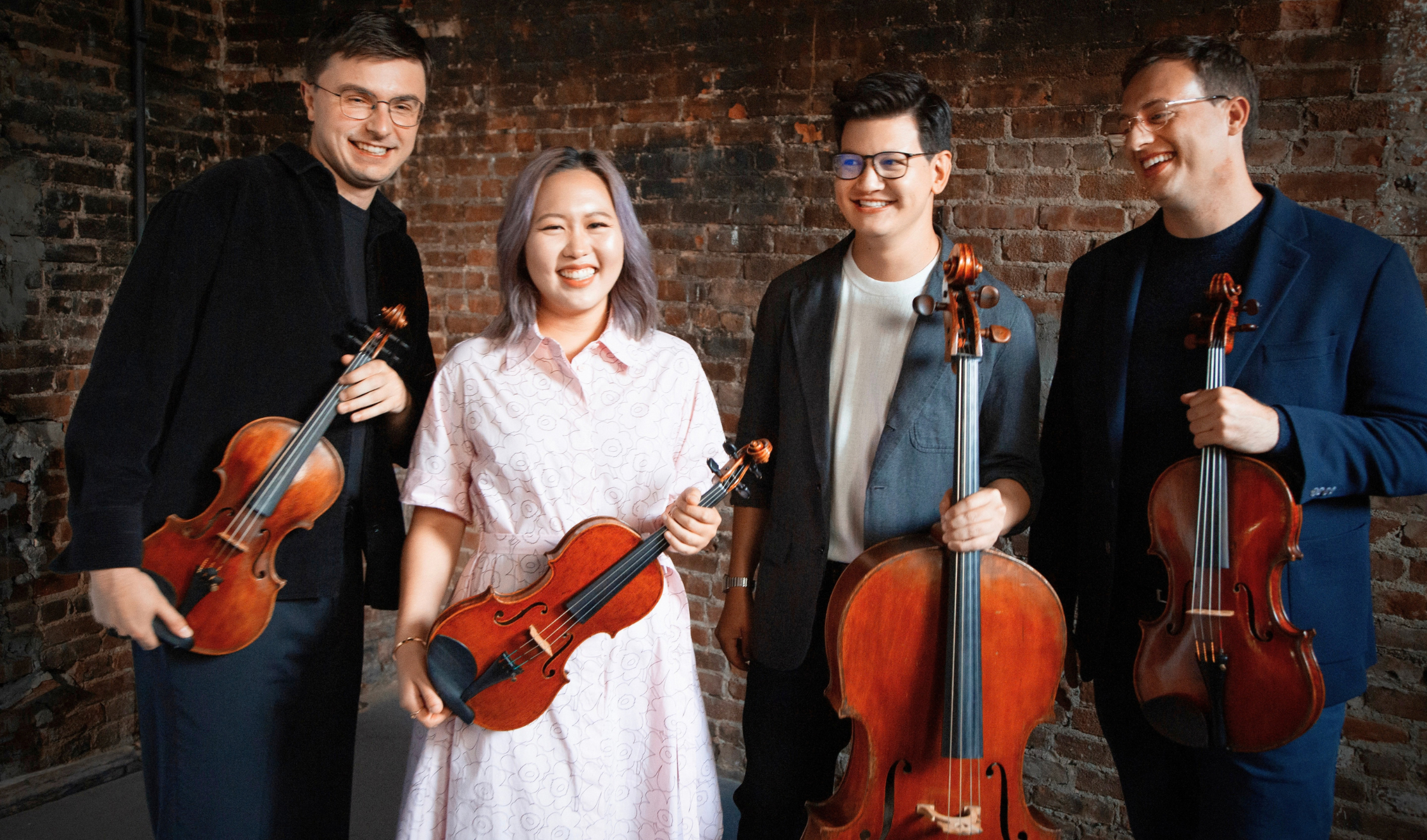
Music at the Mill: Balourdet Quartet Join us at Dutchman’s in Brunswick for our winter Music at the Mill Concert. The evening includes a wine and beer social hour, chamber music concert, and gourmet pizza reception. The Balourdet Quartet, alumni of the Festival’s String Quartet Fellowship, returns to Brunswick! The Quartet was awarded the Avery Fisher Career Grant and Chamber Music America’s Cleveland Quartet Award in 2024 and was recently named the inaugural fellow of the Resonance String Quartet Fellowship. Read more about the Balourdet . Balourdet Quartet Angela Bae, Justin DeFilippis, violin • Benjamin Zannoni, viola • Russell Houston, cello BÉLA BARTÓK (1881–1945) String Quartet No. 6, Sz. 114 JOHANNES BRAHMS (1833–1897) String Sextet No. 1 in B-flat Major, Op. 18 Angela Bae, Justin DeFilippis, violin • Benjamin Zannoni, Phillip Ying, viola • Russell Houston, David Ying, cello — Video: Balourdet Quartet Plays Brahms 6:00 PM: Doors and Bar Open Join us for beer and wine before the concert. 7:00 PM: Concert 8:15 PM: Post-Concert Reception Join us in the restaurant after the concert for delicious pizza and to chat with the artists. Pizza, beer, and wine are included with your ticket purchase. Program Notes BÉLA BARTÓK String Quartet No. 6, Sz. 114 (1939) Béla Bartók’s sixth string quartet, composed in 1939, represents the final installment in one of the great cycles of twentieth-century chamber music. It is also an artifact of a tumultuous time in geopolitics, on the eve of World War II. Bartók was morally troubled, not to mention professionally inconvenienced, by the 1938 annexation of Austria by Hitler’s Germany. His publisher, Universal Editions, had become Nazified, with Bartók required to make bogus declarations about his “racial” identity. Meanwhile, he feared the potential implications for neighboring Hungary: “There is danger of seeing Hungary, too, handed over to this regime of robbery and murder.” At once a fervent patriot who had witnessed his nation’s independence from Austria two decades prior, and a committed internationalist who sat on the artistic committee of the League of Nations, Bartók faced a dilemma: should Hungary be annexed, “it would be my duty to exile myself, if possible,” he reasoned. “But it would cause me immense trouble and moral anguish to make my living in a foreign country.” Bartók was invited to take refuge in Switzerland thanks to Paul Sacher, a conductor and major patron of modernist music, who had recently commissioned Bartók’s Musique for Strings, Percussion, and Celesta . Bartók seized the opportunity and settled in Saanen, near Bern, for the summer of 1939, distracting himself by composing a Divertimento for Sacher’s chamber orchestra and beginning his sixth quartet. But Bartók’s progress was brutally interrupted by news of his mother’s death, and he returned to Budapest and completed the quartet under adverse circumstances. It is difficult not to feel Bartók’s anguish, both at the state of Europe and at the loss of his mother, in the insistent indication “Mesto” (Sad) with which he characterizes each movement. The sixth quartet was the last work Bartók completed in Europe. In 1940, he and his family immigrated to the United States, where Bartók spent his remaining years in what he described as “comfortable exile.” It is on a similar, gently uplifting note that his final quartet concludes: open fifths in the violins, and an enigmatic sequence of magical harmonies, plucked by the cellist, left to resonate. JOHANNES BRAHMS String Sextet No. 1 in B-flat Major, Op. 18 (1859–1860) Despite trying his hand at string quartets during the 1860s, the specter of Beethoven’s quartets continued to loom over the genre. Brahms would not feel satisfied with his attempts until 1873, when he was nearly 40. String quintets, meanwhile, were the province of Mozart (in two viola configuration) and Schubert (in two cello configuration), and Brahms’ early attempts to compose string quintets would prove even m
Photos

No photos yet.
Be the first to add a photo of this event!